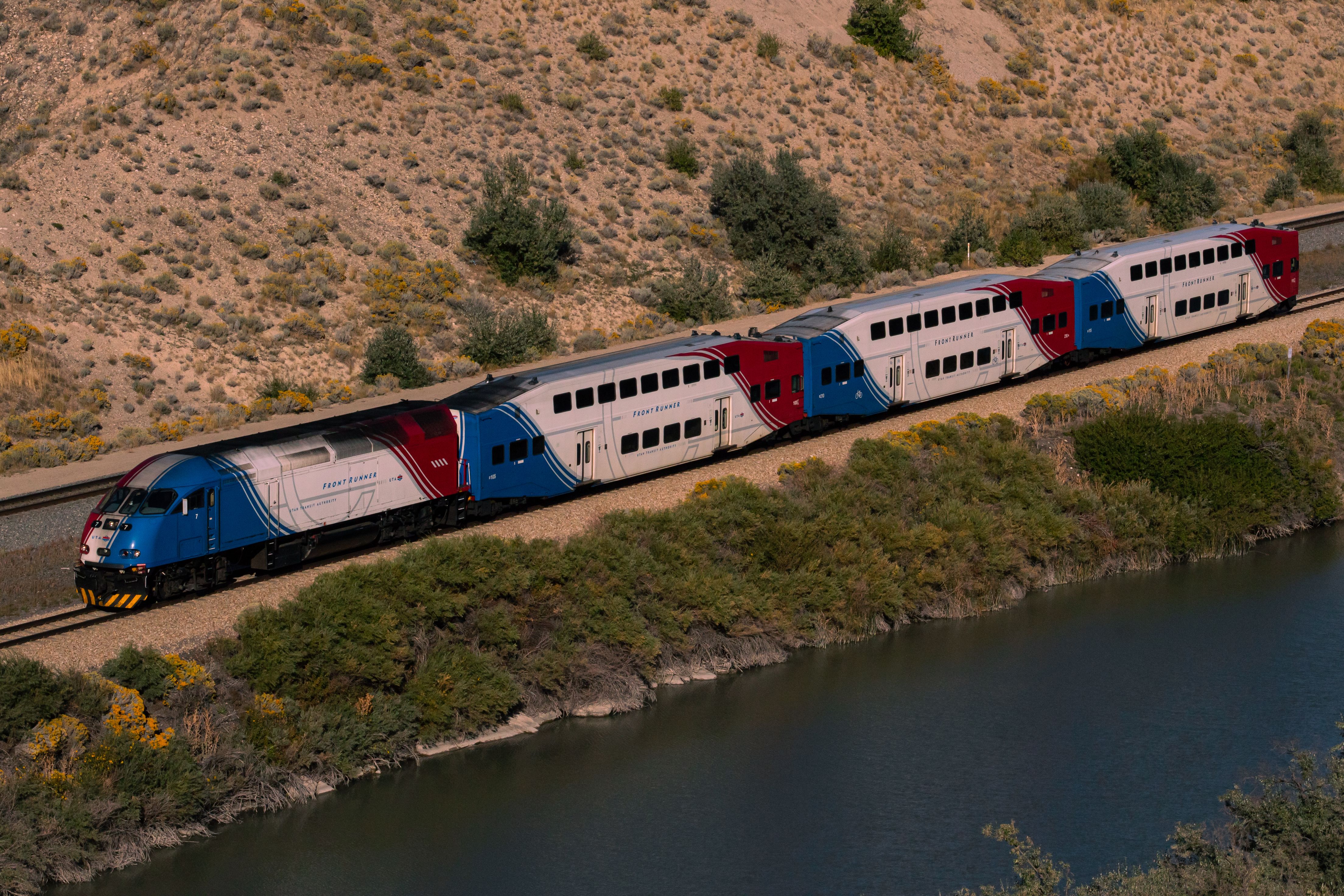
Millcreek commuters who ride FrontRunner could see trains arrive twice as often under a $3.2 billion upgrade now moving through the federal funding pipeline.
The FrontRunner 2X project, a partnership between the Utah Department of Transportation (UDOT) and Utah Transit Authority (UTA), will add 26.1 miles of double track in 11 locations along the 82-mile commuter rail line between Ogden and Provo. The Federal Transit Administration (FTA) moved the project into the Engineering phase of its Capital Investment Grants program in August.
The payoff for riders: trains every 15 minutes during peak hours and every 30 minutes the rest of the day. FrontRunner runs every 30 minutes during peak periods and every 60 minutes off-peak, according to the project's FAQ page.
No FrontRunner station sits within Millcreek city limits. The nearest stop is Murray Central, one of 16 stations along the line. The project will also add a new station in Bluffdale, 10 new trainsets, signal upgrades and a new maintenance facility.
Funding and timeline
The FTA committed up to $1.28 billion in federal funds, about 40% of the total cost, according to the FTA's engineering profile assigned in August. The state is covering the rest. That federal money still requires a Full Funding Grant Agreement (FFGA) and annual congressional appropriations.
The construction timeline varies by source. UDOT's August announcement said construction is anticipated from 2027 through 2030, subject to the federal grant process. The FTA engineering profile lists a March 2027 FFGA target and a December 2031 completion date. The project website says all segments are expected to be operational by 2030 but notes the schedule depends on federal grants.
"Utah is growing quickly, and preparing for that growth requires a balanced transportation system that goes beyond highways," UDOT Commissioner Carlos Braceras said in the August announcement.
Why single track matters
Most of FrontRunner's route is single track. Trains headed in opposite directions must wait at stations for each other to pass.
"There's a lot of … orchestrating that has to happen to keep the system moving," Brian Allen, FrontRunner 2X project director at UDOT, told Utah Business in a Nov. 11 article. A problem on one section can delay trains in both directions, and the limited passing points cap how often trains can run.
Once complete, more than half the route will be double-tracked, according to Utah Business.
No fare hike, service continues during construction
The project FAQ states fares will not change. FrontRunner will keep running during construction, with UTA providing bus bridges or other connections as needed.
The upgrade also opens the door to Sunday service. UTA uses Sundays for track maintenance that requires the single-track line to shut down. Double tracking would create room for seven-day-a-week operations, according to Utah Business, which quoted Gavin Gustafson, UTA senior public information officer, saying the project does not pay for Sunday operations and UTA is still working to secure that funding.
Olympics and long-term growth
The project is tied to Utah's preparations for the 2034 Winter Olympics. UTA's statement on the Games lists FrontRunner improvements, including 15-minute frequency and Sunday service, among projects that will support the event.
The Wasatch Front population is expected to grow 43% by 2050, reaching 3.65 million residents, according to the project FAQ. FrontRunner is at 90% capacity during peak times and peak direction.
Residents can sign up for project updates, including construction timelines and traffic impacts, at frontrunner2x.utah.gov.