A proposed federal bill would permanently shield Millcreek Canyon and the surrounding Central Wasatch Mountains from new road construction, ski resort expansion and public land sales.
The Central Wasatch Commission (CWC) published a detailed report on Thursday, Sept. 3, explaining the Central Wasatch National Conservation and Recreation Area Act (CWNCRA), a bill the commission is redrafting for introduction to Congress by 2027. Sam Kilpack of the Central Wasatch Commission wrote the report.
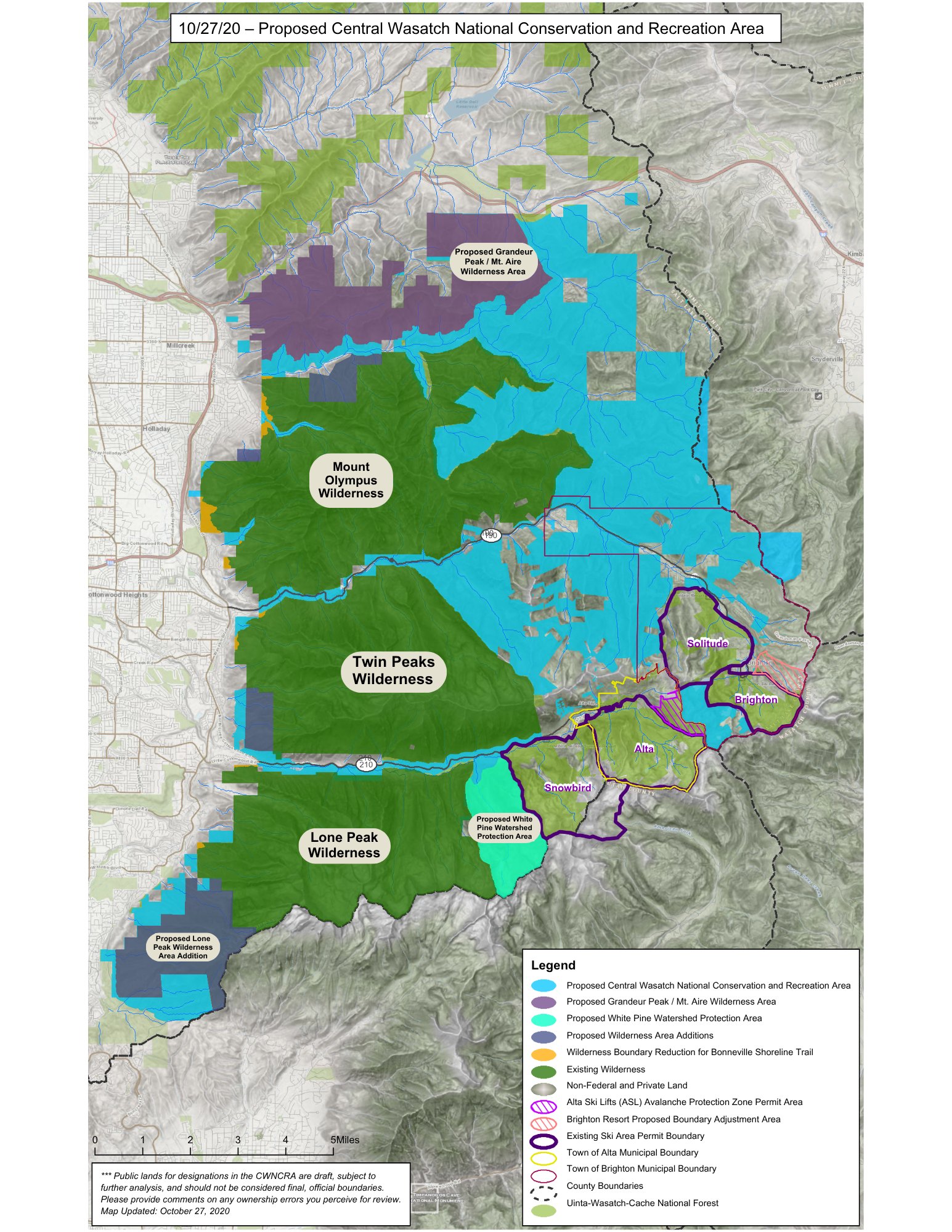
The legislation would create three layers of protection on existing U.S. Forest Service land across the tri-canyon area of Millcreek, Big Cottonwood and Little Cottonwood canyons. Most of the affected land would become a National Conservation and Recreation Area (NCRA). Roughly 8,000 acres of new Wilderness would be added by expanding the Mount Olympus, Twin Peaks and Lone Peak wilderness areas and creating a new Mount Aire/Grandeur Peak Wilderness Area. A separate 1,800-acre White Pine Watershed Protection Area would be designated next to the Lone Peak Wilderness.
What the bill would block
Within the NCRA, the bill would prohibit construction of new roads except for emergencies or administration. It would bar ski areas from expanding beyond their current operating footprints and restrict motorized and mechanized travel to designated roads and trails. The four ski resorts in the Cottonwood Canyons would keep their existing permits and operations unchanged.
Mountain biking would still be allowed in the NCRA but not in designated Wilderness areas.
What it would not change
Private property owners within the boundaries would see no change to their land or access. The bill explicitly prohibits condemnation and forced sale of private land. Transportation improvements, including roadway upgrades, public transit, trails and bike lanes, would remain permitted. The Utah Department of Transportation (UDOT) could continue avalanche mitigation work without restriction.
Why the CWC says it matters
The protections would be permanent, removable only by an act of Congress. That distinguishes the CWNCRA from a National Monument designation, which can be altered by executive action.
The CWC report frames the bill as a direct counter to two active threats. The first is a federal proposal to rescind the 2001 Roadless Rule, which currently protects about 28,500 acres of Forest Service land in the Central Wasatch from road building and timber harvest. The second is recent congressional efforts to force the sale of 2 to 3 million acres of public land that could include roughly 29,000 acres in the Central Wasatch.
Jeff Silvestrini, then Millcreek's mayor and CWC board chair, called the CWNCRA "our best way forward" in an October 2025 CWC statement opposing the Roadless Rule rescission. He said the bill could shield those 28,500 acres from future threats.
The bill traces its roots to the Mountain Accord Charter, signed in 2015 after a proposal to force the sale of Forest Service land to a ski company for a gondola connecting Big Cottonwood Canyon to the Wasatch Back. Then-Congressman Jason Chaffetz introduced the first version in 2016, but it stalled in the House Natural Resources Committee. The most recent draft dates to October 2020, and the CWC notes that specific provisions may change in the upcoming redraft.
If signed into law, the CWNCRA would require the Forest Service to update its 2003 management plan within three years. The Central Wasatch Mountains draw more than 3 million visitors a year, according to the CWC.
How to comment on Roadless Rule rescission
The U.S. Department of Agriculture released a draft environmental impact statement Aug. 20 on the proposed Roadless Rule rescission. As The Salt Lake Tribune reported, the public comment period closes at midnight Monday, Sept. 21. Comments can be submitted at regulations.gov under Docket No. FS-2025-0001.