A drone flying over Utah's Cottonwood Fire in late June forced firefighting planes to stand down for about an hour, grounding the same air support Millcreek used during an Aug. 4 blaze near the mouth of Parleys Canyon.
The incident, reported by The Salt Lake Tribune, is part of a national surge in illegal drone flights over active wildfires that fire officials say is putting pilots' lives at risk and letting fires grow unchecked.
For Millcreek residents, the threat hits close. The Parleys Canyon corridor has seen three grass fires since early July: a brush fire near Tanner Park on July 12, a fire near the I-80/215 interchange on Aug. 3 and the Aug. 4 fire near Canyon Rim that drew helicopters and air tankers from Idaho. Those aircraft used Canyon Rim Elementary School as a water-dip site. A single drone in that airspace could have shut the operation down.
A growing national problem
The Cottonwood Fire was burning east of Beaver and was then Utah's largest active wildfire. When a drone appeared overhead, crews had no choice but to pull planes from the sky.
It wasn't an isolated case. Less than three weeks later, a drone grounded firefighting aircraft over a southwestern Colorado fire for about two hours. In Spokane County, Washington, drones have been spotted above active fires nearly 40 times this summer, according to Tom Stokesberry, spokesperson for the multi-agency team fighting those blazes.
"We're here trying to help this community in their time of need — and it's a real time of need," Stokesberry said. "When we're hampered by a drone flying over the fire, that really frustrates us."
In 2025, the U.S. Forest Service recorded more than 200 drone sightings above wildfires nationally. A drone collided with a firefighting plane above the Palisades Fire in Los Angeles that year, threatening the pilot and removing the aircraft from service for months.
Why drones ground planes
Firefighting aircraft fly low to drop water and retardant, putting them in the same airspace as consumer drones. Cal Fire spokesperson Linnea Edmeier said even a small drone can cause a firefighting helicopter to lose control. Fire officials say most drone operators over wildfires are hobbyists chasing photos and video who may not know the rules.
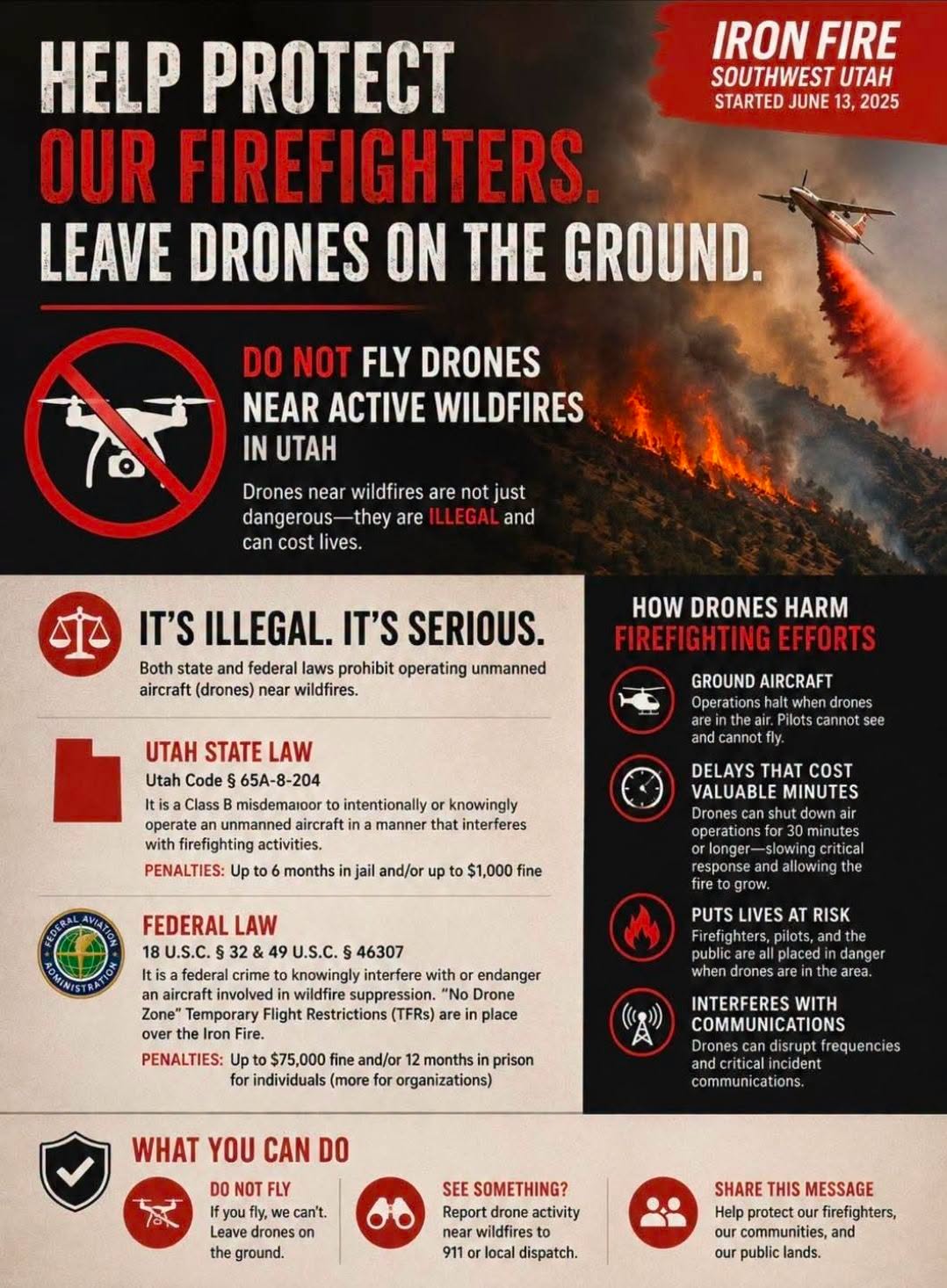
Penalties in Utah and under federal law
Flying a drone into FAA-restricted wildfire airspace is a federal crime carrying up to two years in prison and $175,000 in fines.
Utah adds its own penalties under state code 65A-3-2.5. The law creates a tiered system: a class B misdemeanor and up to $2,500 in fines for entering a wildfire flight restriction without permission, escalating to a class A misdemeanor (up to $5,000) if the drone forces a firefighting aircraft to divert, a third-degree felony (up to $10,000) if the drone contacts a manned aircraft, and a second-degree felony (up to $15,000) if it causes a crash. Under the same statute, an incident commander can legally disable or take control of an unauthorized drone.
What's next
An FBI task force has deployed counterdrone technology near the Spokane County fires, potentially using electric pulses to bring down violating drones. Spokane County Sheriff John Nowels said his office has referred several drone cases to the FAA.
The Unified Fire Authority, Millcreek's contracted fire agency, has not issued a public statement about the drone threat to local operations. With fire season intensifying along the Wasatch Front, residents who fly drones should check for temporary flight restrictions before launching near any wildfire or smoke column.